buy lego turing machine
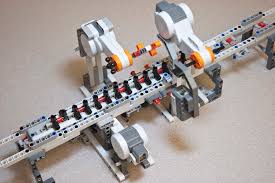
The father of all Lego computers: The Lego Turing Machine 06.18.2012 :: 12:00PM EST @salcan The Turing machine is a tape-based, proto-computer that is capable of working simple algorithms. Known as a kind of “state machine”, it was devised by Alan Turing in the 1930s and is an extremely important part of computer science history. Two men, Jeroen van den Bos and Davy Landman, have built a Lego Turing Machine and shot the video above about their project. A full explanation of the Turing machine is available if you’d like to learn more, but the video explains the basics. The Turing machine works with a tape — which is essentially its program — which is broken down into binary segments. It modern thinking the tape would be populated by 1s and 0s, in Turing’s time it was the same, and in Lego parlance it’s little black rods flipped to one side or the other. The Lego Turing machine uses an optical scanner (the head) which would not have been available to Turing.

It, like the rest of the parts used in the machine, works with the LEGO Mindstorms NXT kit. By running through the tape and using a sensor, switch, and basic logic the machine is able to perform simple operations. In this case the very short tape simply calculates the sum of 2 and 2. At the end of the video the Lego Turing machine correctly identifies the answer as being 4.
shop lego birds The machine was built for the “Turings Erfenis” exposition which honors the 100th birthday of Alan Turing, June 23, 2012.
cheap cool lego setsThe event is organized by the Centrum Wiskunde & Informatica in Amsterdam.
lego shop florida The (very well done) video was shot with a high-end Panasonic AF101 camcorder and a Voigtlander 25mm f/0.95 lenses as well as a number of Nikon AI-s primes lenses including the 35mm f/2.0, 50mm f/1.4, 55mm f/2.8 macro, 85mm f/1.4, and the 105mm f/2.5.
buy lego builders of tomorrow
The use of that Voightlander lens was made possible by using the Novoflex Nikon to Micro Four-Thirds adapter. More at Lego Turing Machine, via Vimeo subscribe to our newsletter: Subscribing to a newsletter indicates your consent to our Terms of Use and Privacy Policy.A group of students at the computer science department at Ecole Normale Supérieure de Lyon built a working replica of a Turing Machine out of Lego bricks, with 20,000 elements used including 32 pneumatic cylinders, 50 meters of pneumatic tubing, and over a thousand gears!
lego shop holiday Turing machines consist of a tape, a head that reads and writes symbols on the tape, a state register that stores the current status of the machine, as well as an “action table” that stores processes for writing and erasing symbols in the table.
lego shop ontario
Now imagine doing that all with Lego…A moving tribute to the father of computer science. This working Turing Machine was built by Jeroen van den Bos and Davy Landman at CWI in Amsterdam in honour of the centenary of Alan Turing's birth on 23 June 1912. The original device was described as an "a(utomatic)-machine" by Turing in 1936 and intended as hypothetical device representing a computing machine rather than a practical computer technology. The mechanism manipulates symbols on a tape according to a table of rules (its "program"). The tape acts as the computer’s memory allowing the machine to simulate the logic of any computer algorithm. Find out more about the Alan Turing Centenary Year here. If you want more Lego computers, here's a 2000 year old mechanism built from the tiny plastic bricks. Related Links and Media Lego Turing Machine (95 x 30 x 20 cm) Lego Turing Machine (Reading the Memory) Alan Turing Year (2012) More on the making of this video
Sign up or log in to customize your list. Here's how it works: Anybody can ask a question The best answers are voted up and rise to the top I followed the instructions on LEGO Turing Machine and succeeded to build it. Next I've tried and failed to program it using NXT Mindstorm GUI. The site mentions a Rascal framework, but it doesn't mention how to install it onto the NXT. I'm not so keen using Rascal, any other well documented framework will do. I'm using NXT 2.0 Sign up or log in Sign up using Google Sign up using Email and Password Post as a guest By posting your answer, you agree to the privacy policy and terms of service. Browse other questions tagged nxt mindstorms or ask your own question.Everyone reading this post can thank Alan Turing for the privilege. Turing is widely considered the father of computer science: he cracked Nazi crypto-codes during World War II and helped design the first working computer. But before all that, at the tender age of 24, Turing had the central theoretical insight behind every shiny gadget you know and love: a hypothetical, idealized computer called a Turing Machine.

To celebrate the 100th anniversary of Turing’s birth, a team of geeks from the Netherlands decided to explain to the world just what the heck a Turing machine is—by designing and building one of out Lego. A Turing machine is a computer boiled down to its purest, simplest form. That was the point: Turing conceived of his eponymous machine before any actual computers existed, as a thought experiment that would help illuminate just what, exactly, a computer could do. It turns out that all you need to "compute" something is a paper tape divided into cells; a "write head" that can place marks on the tape or remove them, one cell at a time; and a table of instructions for how the "write head" should move backwards or forwards along the tape. Turing proved that if enough time and tape were available, this "machine" could handle any computational task thrown at it. In plain English, this means that anything and everything that modern computers can do—from playing back video and sending tweets to analyzing stock markets and autopiloting spacecraft—can be done by Turing’s paper-powered gewgaw.

(Technically, it’s the reverse: the Turing machine proved that real-world computers would be able to do all those amazing things, even before anyone was able to build them.) Turing machines are simple, but still hard to visualize for most laypeople. That’s why Davy Landman and Jeroen van den Bos, two computer-science PhD students in the Netherlands, decided to build one. "We hoped that having a real working computer built from Lego would make the theory behind it more approachable," van der Bos tells Co.Design. "Lego is one of the few toys that everybody knows, so this would make it recognizable to a very large group of people. We felt this was important because our goal was to show that the concepts underlying all computers are not extremely complicated and can be understood by anyone." The Lego Turing Machine took about 60 hours to design and build. Instead of a paper tape and written marks, it uses 32 black Lego Angle Connectors as switches that a robot arm flips up or down.

"It was just the total amount of Angle Connectors that we had lying around," van der Bos says. "Also, for demonstration purposes, it’s long enough—calculating 2+2 takes about five minutes and requires ten switches and 33 instructions." Watching the Lego Turing Machine grind out answers to simple arithmetic problems by flipping single switches back and forth may not seem like the most thrilling visual spectacle in the world. But when you consider that your laptop is doing the exact same thing, millions of times every second, the (yes, I’ll use the word) awesome power of the Turing Machine becomes a bit clearer. Whether it’s displaying retina-quality screen imagery at 30 frames per second, running Angry Birds, or parsing the contents of this blog post, everything and anything your computer can do—and ever will do—all comes down to the same thing in the end: flipping little switches back and forth, back and forth. Van der Bos and his collaborators intend to release building instructions for their model so that anyone can create a Lego Turing Machine of their own.